Case 1
Sticky notes keep growing until they cannot be read
IAF competency reference B
Plan Appropriate Group Processes
1. Read the situation
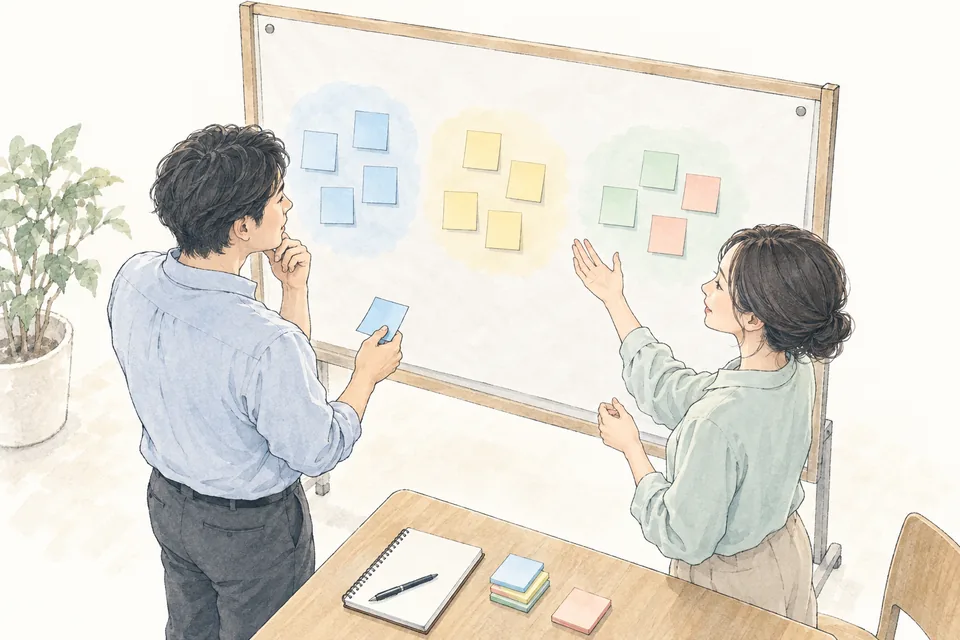
Ideas from 20 people cover the wall. Some use the same words with different intentions; others differ only in how they are phrased.
- There are 86 sticky notes on the wall
- No one other than the authors has explained their meaning
- Selection criteria have not yet been agreed
2. Predict what comes next
If you vote immediately, how will prominent wording and duplicate ideas affect the result?
Input is not sent and is lost when you leave the page. Do not enter personal information or the names of real people.
3. Choose an intervention
4. Check the result and reasons
Without JavaScript, all three choice results are shown.
Result of choice A (Recommended)
What happens: overlaps and differences become visible and can be compared.
Reason: Treating categories as hypotheses rather than conclusions allows you to organise ideas while checking their authors' intentions.
Result of choice B
Failure example: votes split across duplicate ideas, while striking wording gains an advantage over substantive importance.
Reason: Voting before preparing comparable units amplifies bias from the number and appearance of ideas.
Result of choice C
Failure example: differences in the intentions of apparently similar ideas disappear, and participants cannot check why they were deleted.
Reason: Organisation and decisions rely only on the facilitator's interpretation, without checking with the people who proposed the ideas.
Typical failure
Voting without organising, or organising alone as facilitator, loses the meaning of ideas and the decision process.
Recommendation for this case
Work with participants to group ideas with similar meanings provisionally, and write short headings for each group's common points and differences.
Reason: Treating grouping as an intermediate output for comparison allows relationships to be examined before reducing the ideas.
Read the KJ MethodPractice pack: 15 minutes
A 15-minute practice grouping 12 cards
- Two roles
- Person grouping the cards / Person asking about meaning
- Rehearsal
- Organise 12 examples with similar meanings by placing them provisionally, checking, and adding headings, in that order.
- Observe
- Have the authors' words been rephrased without permission?
- Have uncertain cards been forced into groups?
- Can the differences between groups be explained?
- Debrief
- Which combination was hardest to decide?
- What words communicate that the grouping is provisional?
- What to take away
- Record group headings, cards left at the boundaries, and unanswered questions on one sheet.
Try this briefly with two colleagues, not the actual session's participants. The organiser separately judges safety and suitability for the real session.